
Keep On Tugging
Is There a Growing Trend of Men Who Want Their Foreskins Back?

I tend to pay a lot of attention to penis news. Or is it penile news? It’s kind of my job, and it’s way more fun than most of the news we hear these days (except the algae-filled reflecting pool—that one is filling me with joy because it’s just such a visual metaphor). So I’m surprised that I missed a story from The Cut in April that sparked a whole bunch of other stories about men who want their foreskins back.
The articles touted (or warned of, depending on the author’s bent) a growing trend among men who are so upset by the loss of their foreskin to routine circumcision as infants that they’re willing to go through painful procedures to get it—or some version of it—back.
Writing for New York Magazine’s The Cut, Bianca Bosker strikes a sympathetic tone. She begins her article with the story of Daniel Floyd who says he started having dreams at age four about being strapped to a table and having his genitals cut off. By middle school, he said, the feel of his penis rubbing against his underwear made him uncomfortable and angry. At 18, he ordered a kit to stretch his foreskin and spent the next decade wearing various devices including tension rods and cones attached to an elastic strap that he wrapped around his leg. All of this was supposed to stretch the skin on the shaft of his penis enough that it would mimic the foreskin that had been removed. It did not. He opted for surgery before his 30th birthday.
Male circumcision has gone in and out of style in this country. When my great-grandfather, Dr. Abraham Ravich, was practicing urology in Brooklyn in the 1930s and 40s, only his Jewish patients were circumcised. (Both Jews and Muslims practice ritual circumcision.) He noticed that his circumcised patients had fewer cases of what was then called Venereal Disease (VD) and a lower incidence of penile cancer. Later he wrote a paper about how their wives seemed to be less likely to get cervical cancer.
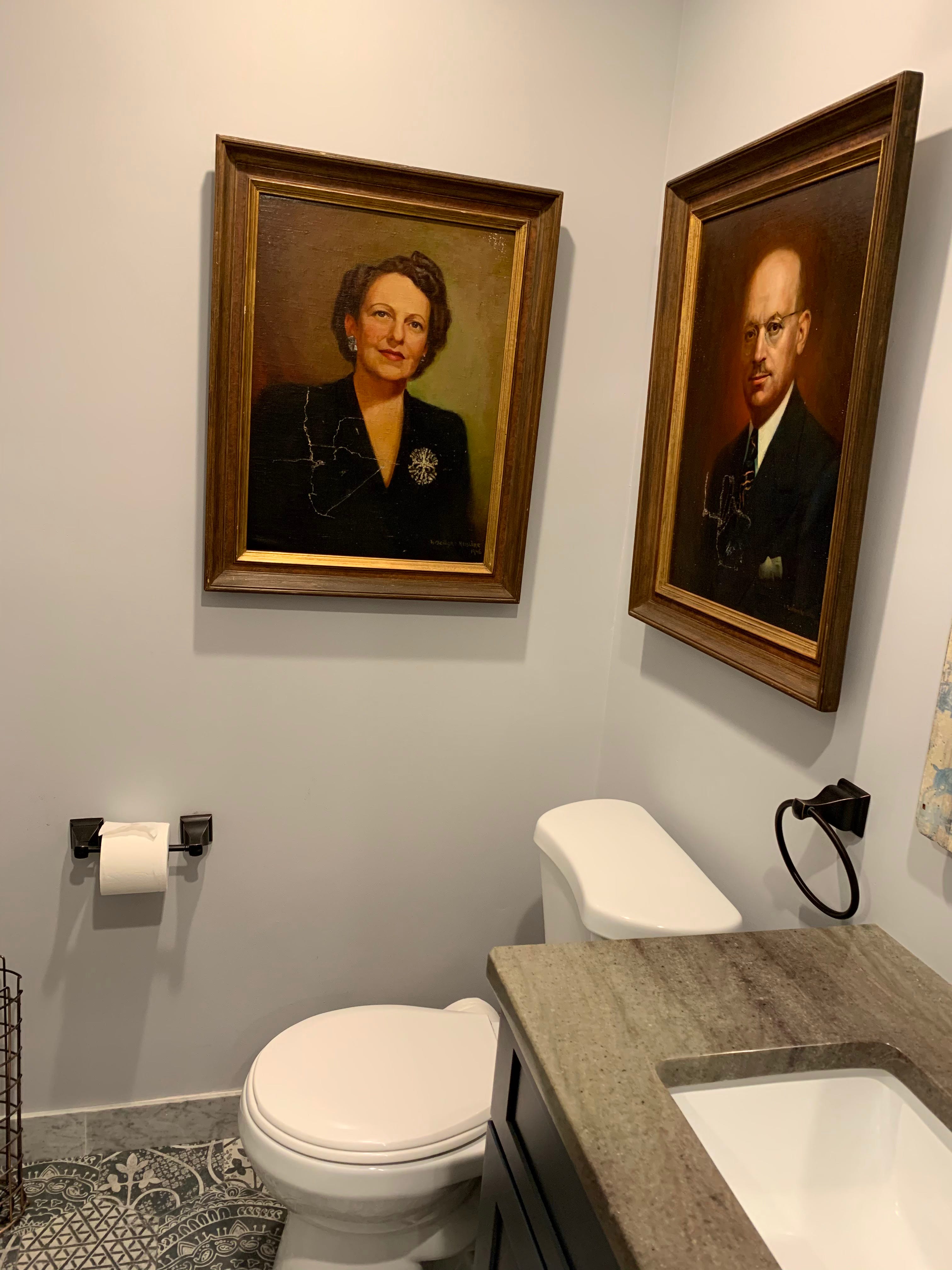
This was years before HPV (human papillomavirus) was discovered and linked to cancers of the cervix, penis, vulva, vagina, head, neck, and throat, but it was the start of the medical establishment realizing that circumcision had health benefits. Poppy Abe (whose portrait hangs fittingly in my powder room) was one of many doctors who pushed for more circumcision in this country. In fact, anti-circumcision advocates—who call themselves “intactivists”—refer to him as the “original zealot.” To their horror, by the mid-1960s an estimated 80% of males born in the U.S. were circumcised.
Discussions of the health benefits of circumcision continued over the years—especially as part of research into HIV transmission. The most compelling evidence comes from three randomized controlled trials done in the early 2000s that found male circumcision decreases HIV acquisition by 53% to 60%, HSV-2 (genital herpes) acquisition by 28% to 34%, and HPV prevalence by 32% to 35% in men. It also helps their female partners: bacterial vaginosis was reduced by 40% and trich infections were reduced by 48%.
This research was enough for the American Academy of Pediatrics (AAP) to change its guidelines on circumcision in 2012 to something not quite as middle of the road. AAP says that “the preventive health benefits of elective circumcision of male newborns outweigh the risks of the procedure.” It says that all parents should be informed of these benefits and be offered the option of circumcision, and that insurance companies should pay for the procedure. The AAP stopped short, however, of recommending routine circumcision for all babies with penises.
Intactivists argue that the benefits of circumcision are easy to replicate with basic hygiene, especially in places like the U.S. where HIV rates are low and other prevention methods such as PrEP and condoms are readily available. They also argue that the very thing that makes foreskins more susceptible to STIs—the mucous-membrane-like skin on the inside—makes them more sensitive to the touch and makes removing them cruel.
The Cut’s Bosker writes:
Other men, while largely pleased with their circumcised penises’ performance, are haunted by the thousands of nerve endings that got lopped off with their foreskin and the additional pleasure they may be missing. In its uncut state, the flesh at the tip of the penis more closely resembles the mucous membrane inside a mouth than the epidermis on, say, an arm. After a circumcision, the glans builds up a thicker, dryer layer of skin as a defense against clothes and other sources of abrasion—a mild callus, basically, like the rough patches on our knees and elbows.
Though most parents have likely not thought about it in these terms, circumcision rates have been going down in this country over recent years. Trends have been regional. When I was pregnant in New York City in 2006, it was assumed that all male babies would be circumcised. I learned in my birth class that you wanted to make sure your OB performed the circumcision and not your pediatrician because OBs are trained surgeons. A friend who had a baby that same year in California said that out there it was assumed that male babies would not be circumcised, and added that her friends who wanted it had to ask more than once. By 2022, only 49% of male babies born across the U.S. were circumcised.
If these kids grow up and want their foreskin back, they are going to find that it takes a lot of effort. Mostly tugging. The skin on the shaft of the penis is loose—it has to be to accommodate the change from flaccid to erect. The idea is that you can stretch it to be even looser so that it will eventually mimic foreskin and cover the head of the penis.
Many do this manually. Others used homemade devices or ones they buy off the internet like MySkinClamp, VacuTract, Foreskinned Air, or Foreballs. Bosker writes:
More enterprising restorers have jerry-rigged their own skin-stretching creations out of pill bottles, ball bearings, aquarium pumps, film canisters, trombone mouthpieces, toilet-seat-hinge bolts, baby bottles, binder clips, a pig-castration device, and baby socks.”
I mean, it’s all ball bearing these days.
Some urologists warn that these devices can be dangerous and cause swelling, scarring, and numbness. They also note that even if you get the look of a foreskin back, it will not work or feel the way actual foreskin does.
The same is true of the surgical options as well. The newest procedure was created by a German urologist who had specialized in making penises longer. Bosker has a detailed description that I encourage you to read only if you’re not squeamish. It involves two surgeries months apart and period of time in which the penis is “sort of [buried] in a tunnel made by the scrotum.” And part of the healing process involves applying clamps to your scrotum for 20 minutes a day for three weeks.
Interestingly, surgery is frowned on by some in the “restorer” community who think you should just Keep on Tugging. KOT is a bit of a motto for them. (Cute, but I think a movement that came up with the monikers intactivists and restorers, should have been able to figure out a way to make that KUT. What about KUtT, Keep Up the Tugging? Or they could channel texting teens and go with Keep Ur Tugging?)
As the great granddaughter of the original circumcision zealot and someone who has been working in STI- and HIV-prevention for my whole career, I’ve been a bit of zealot myself. (As the mother of girls, however, I never had to make the decision for anyone else.) This article may have softened me a little bit (yes, I see the pun). I still have a hard time wrapping my brain around those who say they are mourning a body part they never really knew, and I cannot get behind torturing your penis to get it back. But clearly circumcision, which by nature of being done early is done without consent, has negatively affected some men. I feel sympathy for them.
I’m not a therapist, but this does feel like body dysmorphia. The treatment for that isn’t to change the body, but to address the underlying psychological cause. Like with men who are unsatisfied with the size of their penis, I think the goal should be acceptance of what they have and not a quest to create someone else’s dick by hook or by crook.
The good news is that describing this as a growing trend is a bad pun and a stretch (which we now know is also a bad pun). There are clearly some men who are very upset about the lack of a foreskin. A core group of these men have created enough of an online presence (a sub-reddit has 28,000 members) to intrigue other potentially likeminded penis owners as well as a handful of journalists and at least one newsletter writer. But that doesn’t mean there are scads of men out there who want to keep on tugging.
I think it’s telling that the first article I found that describes this as a growing trend was from 2003, and yet I hadn’t heard of restorers until yesterday. Did I mention that I follow penis news for a living? Or is it penises in the news? Penews?
It’s like I said about ball maxxing a few weeks ago; it’s intriguing and potentially newsworthy but, like babyfishmouth, it isn’t sweeping the nation.
PS. I’m disappointed that I made it all the way through editing this issue and recording the podcast without truly noticing that the article that started this all was in The Cut. Worse, I didn’t manage to make a single mohel joke. I’ll do better next week.